Global stability of attractors and basin volumes

Given a fixed point of a dynamical system, a common question is how stable it is to finite perturbations. This question comes up in studying the brain [1], ecosystems [2], and power grids [3], and is common across science. For infinitesimal perturbations, the standard approach is linear stability analysis. What happens if the perturbation is large? One measure of stability is the volume of the basin of attraction of the fixed point, the set of all points that flow to it under the dynamics [4, 5]. Computing volumes in high dimensions is hard for deterministic algorithms [6, 7], so we require randomized algorithms for high-dimensional systems. A free-energy approach for packings was developed in the jamming literature by Frenkel and collaborators [8, 9, 10, 11]. These ideas have not been adopted for general dynamical systems, owing to the method’s complexity [12]. Additionally, the jamming literature has used optimizers as proxies for the true dynamics because of the high cost of integrating the ODE. I showed that previous work on jammed packings overestimated basin volumes because of the use of optimizers, gave a prescription for obtaining correct volume estimates in tractable time with ODE solvers, and developed libraries for estimating basin volumes of general dynamical systems [13].
Code: BasinVolumes.jl · VolumeEstimation.jl · basinvolume · mcpele
Inherent structures on energy landscapes
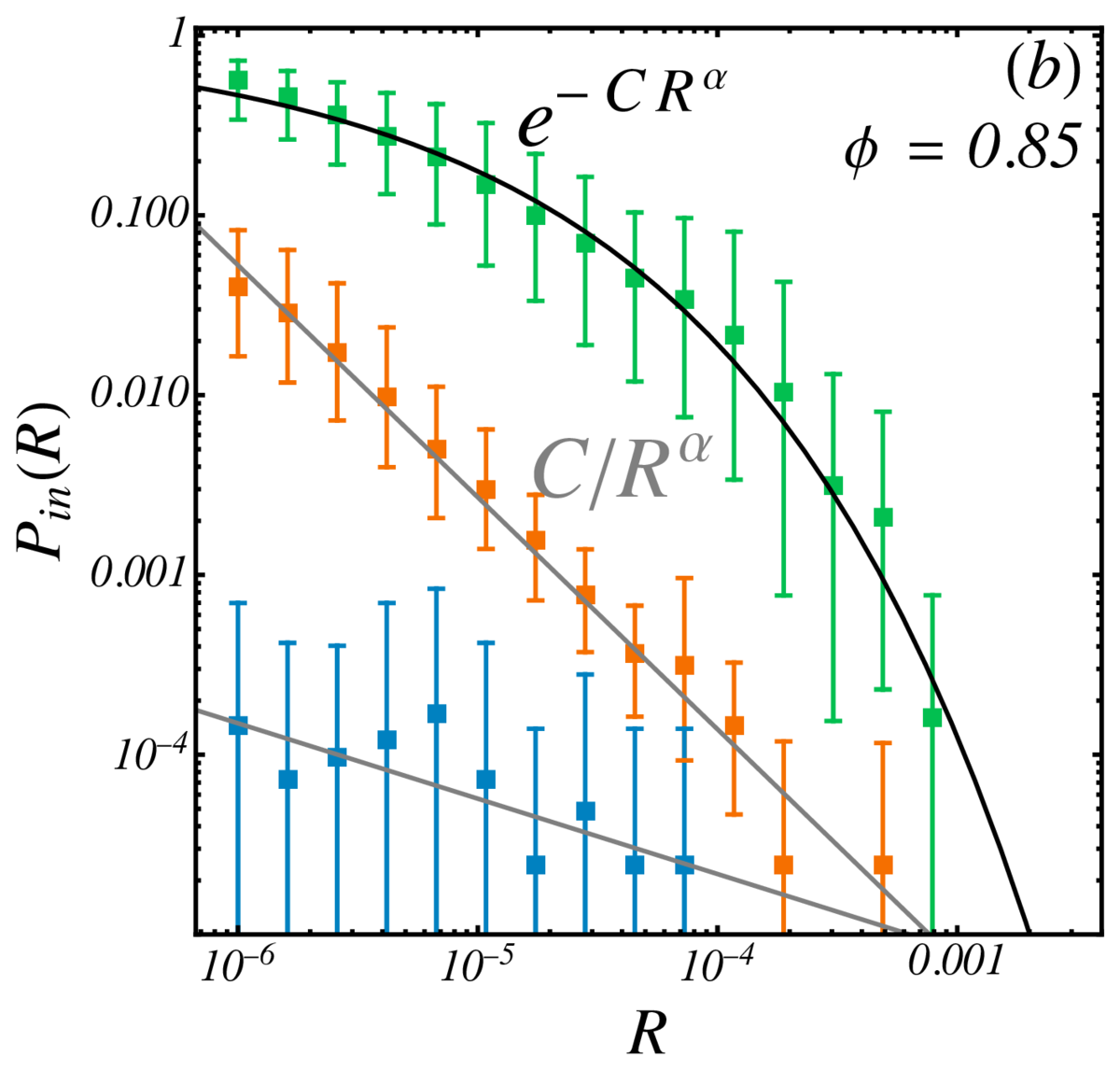
The inherent structure formalism developed by Stillinger and Weber [14, 15] partitions configuration space into basins of attraction and uses this partition to connect the energy landscape to thermodynamics. Starting in 1985 [16], the field began to use optimizers as proxies for identifying basins, because of the high cost of ODE solvers and because the difference did not matter in the contexts then studied. As the formalism spread to larger systems and more varied physical settings, the question of when a proxy solver can be trusted to identify basins remained open. It has been asked over the last twenty years, either by comparing different optimizers with each other [17] or, for small systems, against a ground-truth ODE solution [18]. Yet identifying the inherent structures of larger systems was still described as impossible for greater than 64 particles in 2026 [19]. I showed that they can be identified in much larger systems, up to 1024 particles, and gave a prescription for doing so. Previous work has missed that the steepest descent ODE was stiff and required efficient adaptive BDF solvers for speed. [13, 20].
Code: basinerror · pele
Publications
- P. Suryadevara, M. Casiulis, S. Martiniani. The Basins of Attraction of Soft Sphere Packings Are Not Fractal. PNAS (accepted). arXiv:2409.12113. Code.
- P. Suryadevara. Structure of Basins of Attraction of Soft Sphere Packings. PhD thesis, New York University (2026). PDF · Defense slides.